
Maharashtra
Introduction
Maharashtra’s traditional textiles and crafts reflect its rich cultural heritage and skilled artistry. The state is known for luxurious woven fabrics made with fine silk, cotton, and metallic threads, featuring vibrant colours and intricate motifs inspired by nature and traditions.
Its art forms depict daily life and rituals using simple geometric designs, while leather and wooden crafts showcase elegant, handcrafted items created with age-old techniques. Metal crafts also hold importance, producing beautifully engraved and embossed decorative pieces. These traditions represent the creativity, identity, and heritage of Maharashtra’s people.
Textiles
- Paithani Saree
- Nauvari Saree
- Pune Induri saree
- Karvath kati
- Khan saree
- Narayan Peth Saree
- Chandrakala saree
- Himroo and Mashru
Arts and Crafts
- Bidriware
- Warli paintings
- Bhils
- Ajanta Paintings
- Chitaris- A folk Painting
- Sawantwadi toys
- Kolhapuri chappals
Paithani Saree
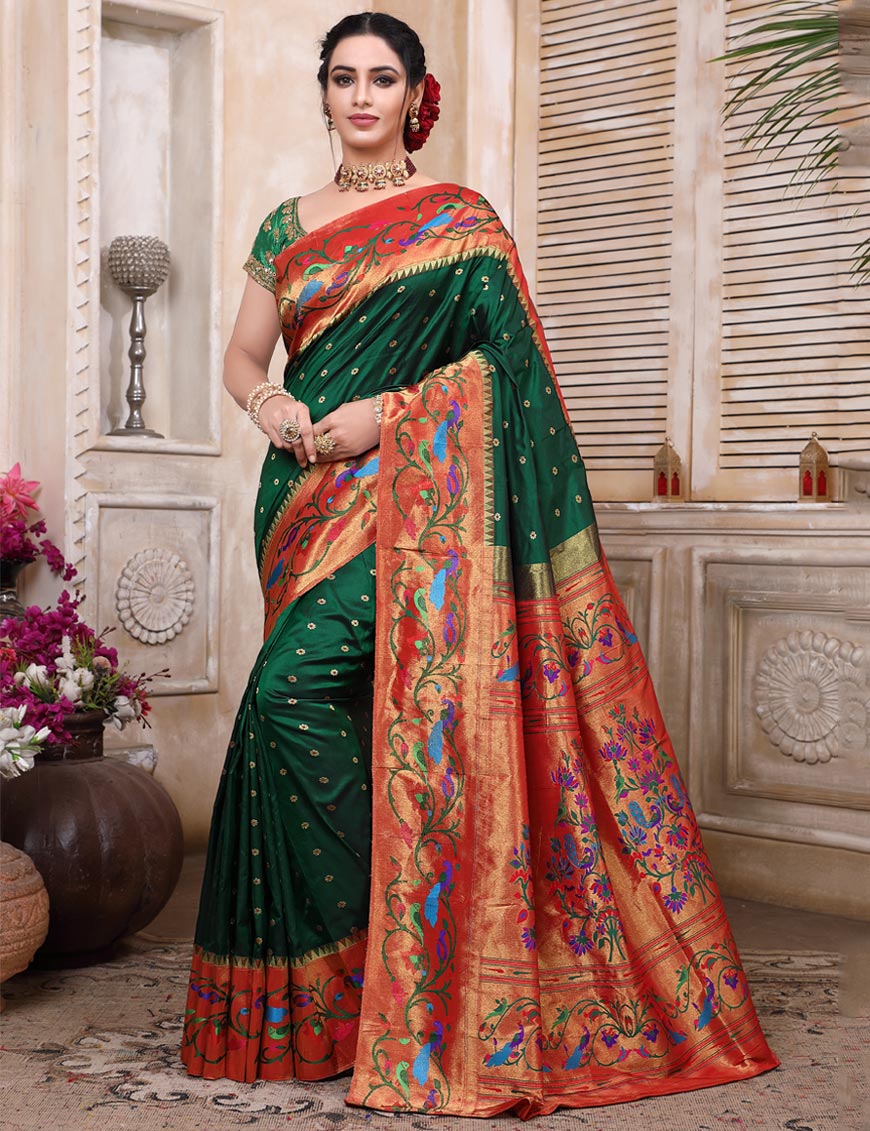
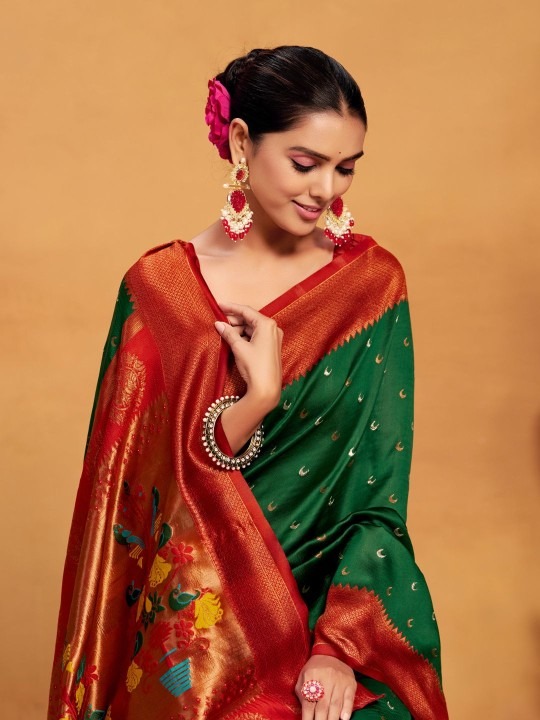
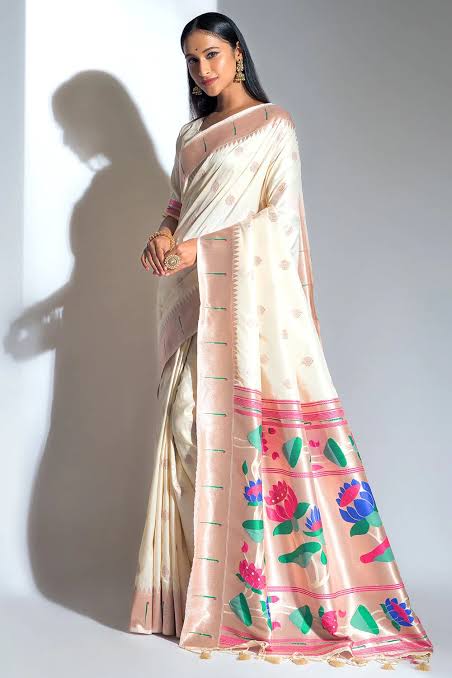
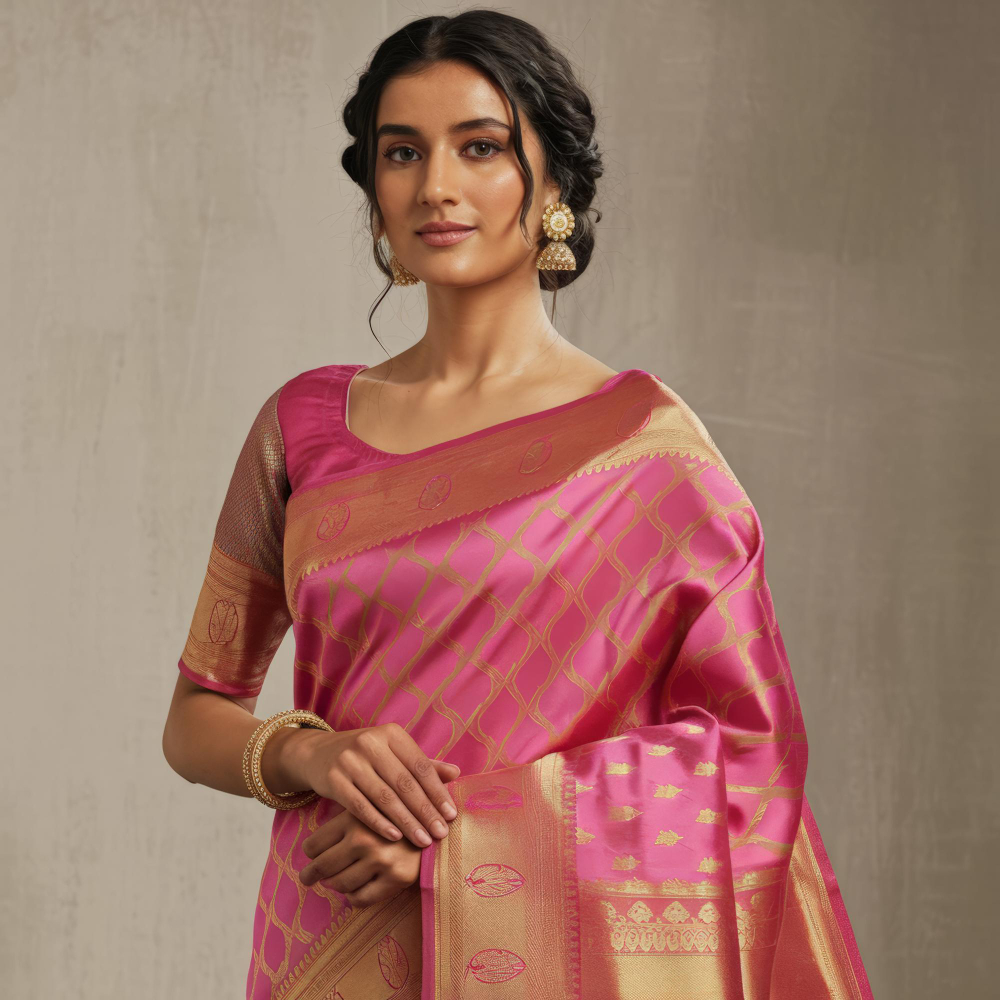
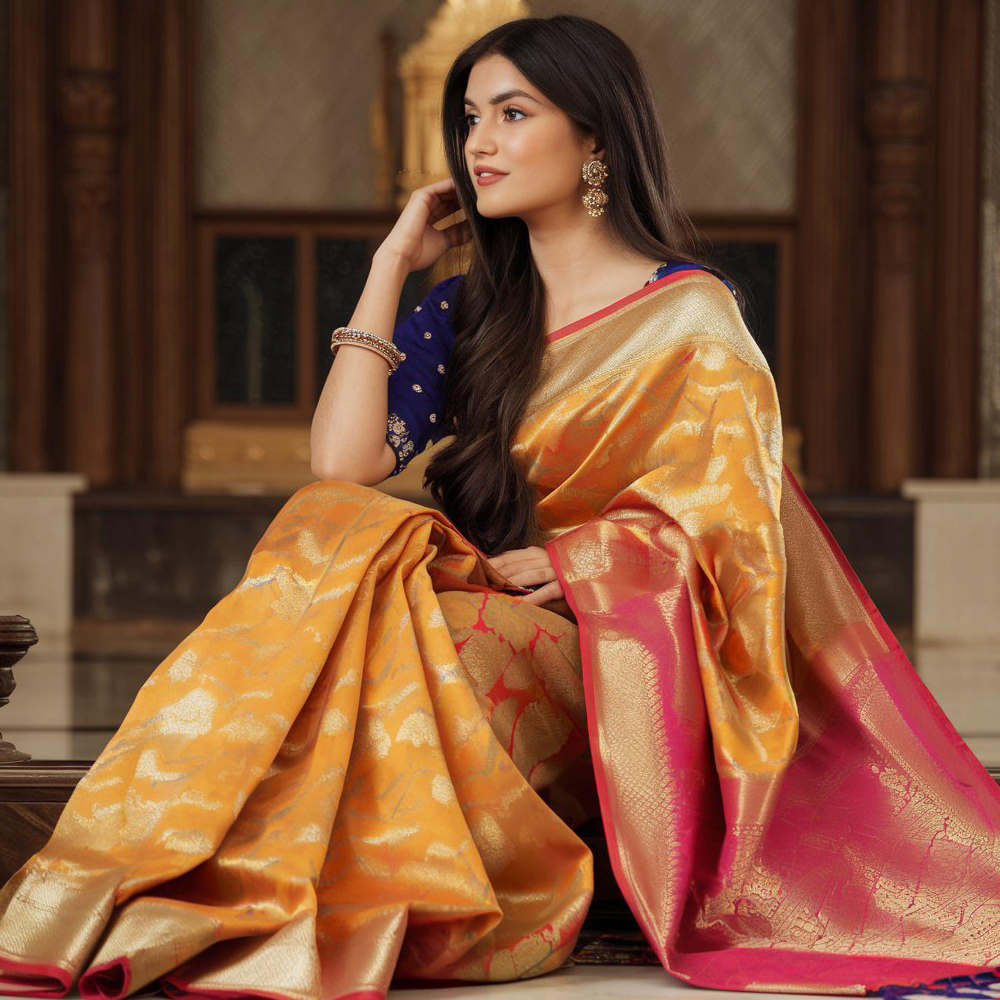
Paithani saree is renowned for its luxurious feel and intricate craftsmanship. It is handwoven using pure silk threads for the body and real gold or silver zari for the borders and pallu, giving it a rich, lustrous appearance. The saree is lightweight yet grand, making it ideal for weddings and special occasions.
- Origin and Regions where practiced.
- Material used
- Colours used
- Manufacturing method
- Types of Paithani
- Motifs – Body | Border | Pallu
- Modern adaptations
Origin and Regions Where Practiced
- Originating from the town of Paithan near Aurangabad, this saree is often called the “Queen of Silks” and is considered a symbol of elegance, royalty, and cultural pride in Maharashtra
Paithani has been mentioned in Buddhist Literature since the 3rd century B.C. The Peshwas patronized the weavers of the paithani, and it was referred to as the “Golden Age of Paithani”. As the location is near to the Ajanta caves, the Kamal or Lotus motif “Ajanta motif” has been found in the sarees. Another recurring motif is the Hans motif (Swan) and coin motif. - The sarees are made in Paithan village, and now it is also produced in Yeola near Nashik.
Materials used
Pure Silk & Real zari ( 1 kg of Gold & 1 tola of copper)
Three types of silk threads utilized :
- Charkha: It is very common. It is inexpensive, lacks luster, and is irregular.
- Ciddle-Gatta: Fine quality silk, thin shear, shiny, smooth and even, fine quality silk.
- China silk: Expensive to work with.
Colours used
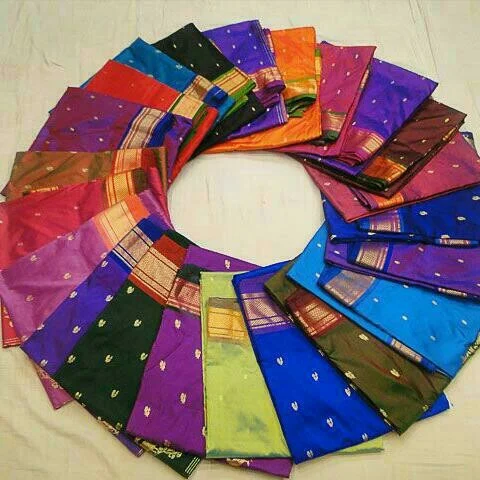
Pitamber(Yellow), Laal(Red), Popti(Parrot Green), Morpankhi(Peacock feather colours), Anjeer(Green, Rust), Samprus(Red, Green), Aboli(Orange, Pink), Vangi(Purple), Motiya(Pinkish White)
Classification by Dyes/colors-
The extremely fine colors of the Paithani silk saris provide it with a special touch. The colors can be single or be produced through the combination of multiple colored yarns. The usual colors used in these saris are:
- ‘Kalichandrakala’: The fine black color and red border are the specialties of this sari.
- ‘Raghu’: Green colored Paithani sari
‘Shirodak’: This is a plain white Paithani sari. The Shirodak is a very classy white saree that is mostly worn by women on a very formal occasion
- Other Names are-
uddani (light black),
pophali (yellow),
neeligungi (blue),
pasila (mix of green, red, and pink), - pheroze (mix of green, white, and red),
sampras (mix of green and red)
kusumbi (mix of purple and red).
Manufacturing methods
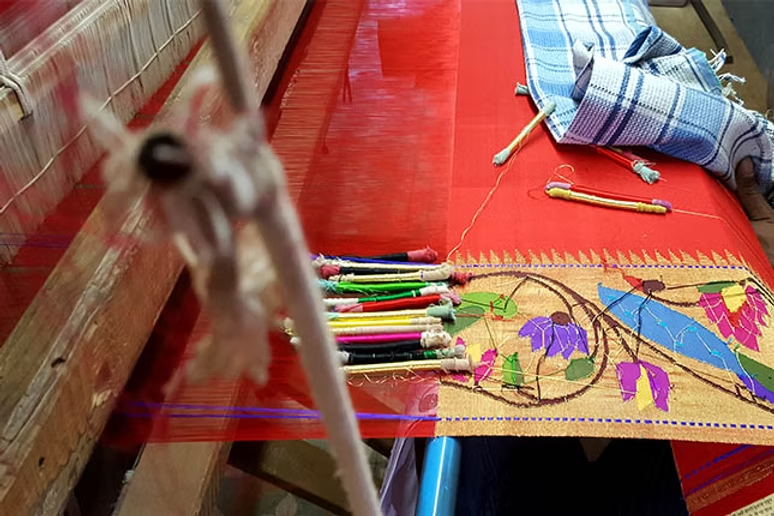
- The tapestry weaving technique is used for paithani saree. Woven in gold and designs are made with the help of silk yarn unwrapped on several shuttles. Original Paithani takes 1 year, whereas semi Paithani takes 2 weeks.
- Pallu- ½ yard to 1 yard with an extension at two corners.
Border- 3 or 9 inches wider
Pallu is bordered by zari and silk threads. The entire border is provided with an outline of a temple or mango motif called Mukri. - Classification by weaving-
Kadiyal border sari – the word kadiyal means interlocking. The warp and the weft of the border are of the same color, while the body has different colors for warp and weft.
Ked/Ekdhoti – one shuttle is employed in the weaving of the weft. Warp yarn color differs from weft yarn color. It possesses narali border and plain buttis such as paisa, watana, etc. Kad is also a type of lungi and is worn by male Maharashtrians.

Types of Paithani-
Traditional Paithani
Brocade Paithani
The traditional type with a 28-inch pallu design takes comparatively less time to weave since the work is less complex.
The brocade Paithani saree, however, contains a complex pallu design of 40 inches.
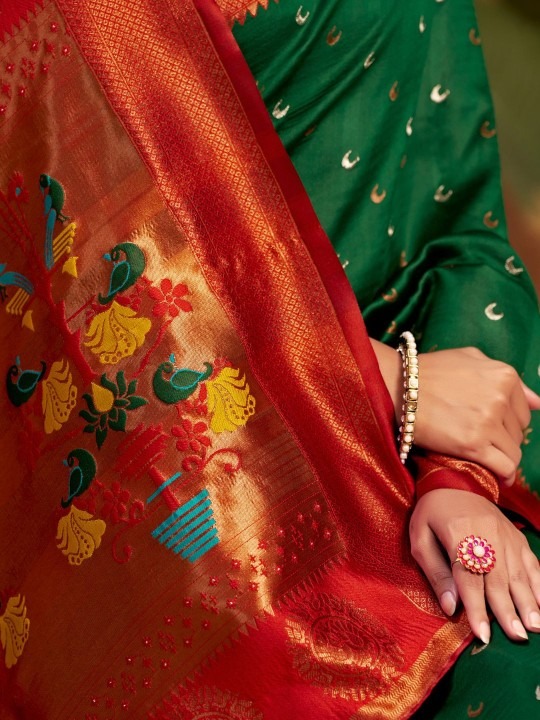
Paithani with a symmetrical border has a conventional pattern on the border, while the pallu contains differently designed motifs such as Parrot, Peacock, Asavali (flower), Ajanta Lotus, Raj Hanse, and Mango. The brocade Paithani is also completely hand woven with borders.
This dress has a royal aura to it primarily because it is woven in the same way as tapestry weaving, as compared to employing conventional weaves.
Borders and the pallu
There are two kinds of borders – the classic Coconut border (Narali) and the Pankha (hand fan).
Paithani sarees can be categorized under three aspects: motifs, weaving, and colors.
Motifs
Ajanta lotus motif, Akruti motif, Kairi motif, Bangdi mor motif
Pallu motifs-
The bangdi mor(peacock in a bangle), Tota Maina (parrot mynah), and Anar(Pomegranate).
Borders-
The common border is a Narali (coconut) border, a diamond shape in a criss-cross design.
- Bangadi Mor – Bangadi is bangle and mor is peacock. So bangadi mor is a peacock in a bangle or bangle shape. The design is woven on the pallu, the pattern sometimes having a single dancing peacock. The sarees with this design are quite costly due to the design.
- Munia brocade – Munia is the name for parrot. Parrots are embroidered on the pallu and the border. Parrots are always leaf green. The silk parrots are also referred to as tota-maina.
- Lotus brocade – lotus designs are used in pallu and occasionally on the border. The lotus design has 7-8 colors.
Modern adaptations in Paithani
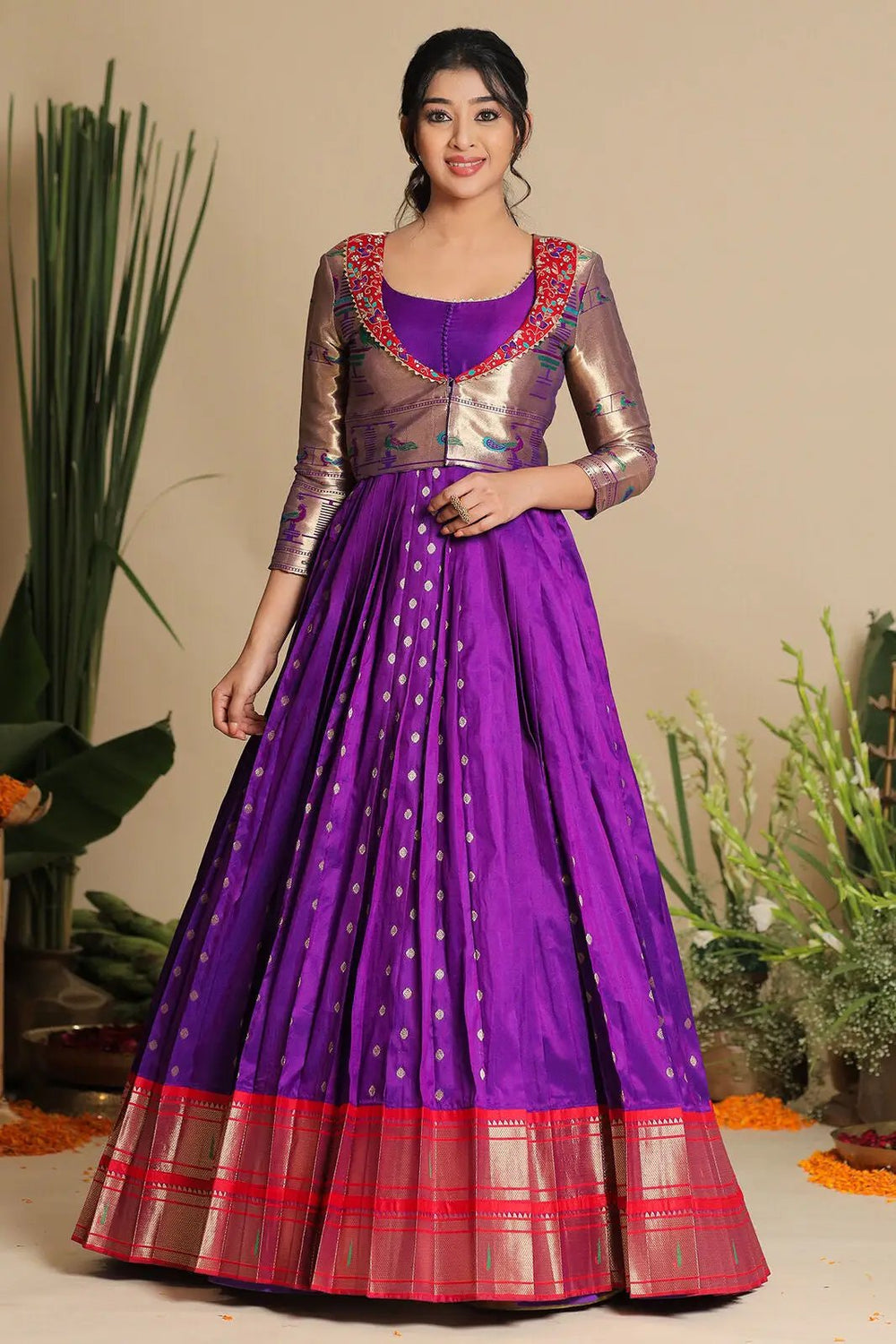
- Recent innovations in Paithani sarees include the adoption of contemporary designs, new color palettes, and fusion wear options, while still preserving the traditional weaving techniques. Designers are experimenting with lighter fabrics, pastel shades, and minimalist designs, as well as incorporating Paithani motifs into non-saree garments like lehengas and gowns. :
1. Contemporary Designs and Styles:
- Fusion Wear:
- Paithani motifs are being integrated into modern outfits like lehengas, gowns, and jackets, making the sarees more accessible for everyday wear.
- Minimalist Designs:
- Some designers are creating Paithani sarees with subtle zari work and pastel silk, catering to those who prefer understated elegance.
- Lightweight Fabrics:
- Paithani sarees are now being made with lighter fabrics like georgette and chiffon, making them more comfortable and wearable.
- New Draping Styles:
- Innovations in draping techniques, such as the lehenga style or pairing the saree with pants, are being explored to give the traditional saree a modern twist.
2. Color Palette and Embellishments:
- Pastel Shades: Young designers are introducing a range of pastel colors like mint green, blush pink, and lavender alongside the traditional vibrant hues.
- Ombre Effects: Gradient color techniques are being used to create a modern, fresh look on the sarees.
- Contrasting Hues: High-contrast color pairings in borders and pallus are becoming popular.
3. Technology and Accessibility:
- Digital Weaving Aids:
- Advanced tools are assisting weavers in creating new motifs and patterns while maintaining the authenticity of handloom weaving.
- E-commerce Platforms:
- Online platforms are being used to showcase and sell Paithani sarees, reaching a wider audience and promoting these innovations.
4. Preserving Tradition:
- Handloom Authenticity:
- Despite the innovations, the core of Paithani weaving – the handloom process and intricate craftsmanship – remains central to the sarees.
- Government and NGO Support:
- Efforts by the Indian government and NGOs to provide training and support to artisans are helping to revitalize the craft and ensure its continuation.
Chandrakala Saree
Place
Maharashtra
Introduction and History
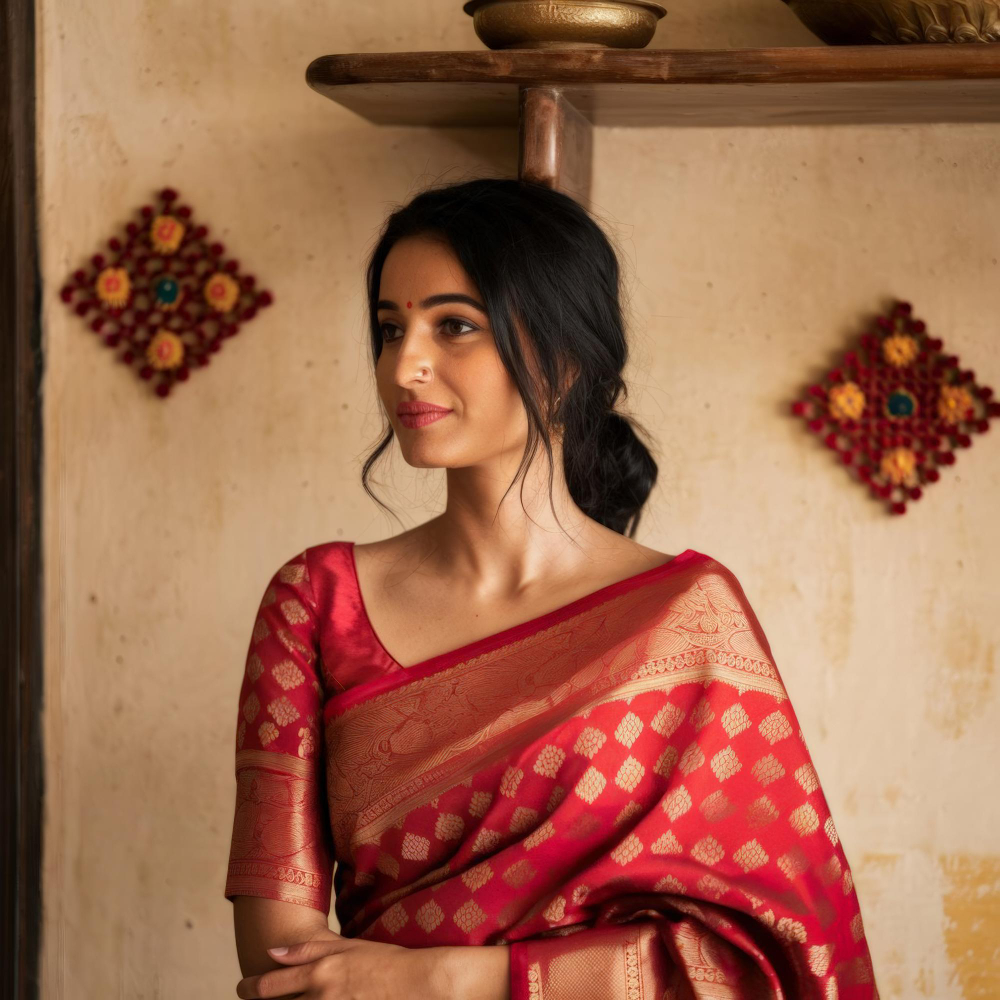
Chandrakala frequently simply referred to as Kali Chandrakala (black paithani having elaborate butti everywhere 9 yards), is one unique Makar Sankranti special saree of one peculiar day on which black draped garment can be used. An impression runs wrong way around when Chandrakala has to necessarily be in color black. The correct substitution happens with the colour being navy blue or midnight blue. The Chandrakala is in dark navy blue color providing a realistic feel of night sky full of twinkling stars. An extra piece of fabric is attached on the upper tucking side to show that the wearer was taller than average and required more width.
Fibers Used
Cotton, Silver Zari (Gold Plated + 5% Gold Content)
Type of Textile
Handwoven with Paithani weave technique
Designs
Khawle Kath/ Narli Kath or coconut border hand weaved throughout rupiya butti, jaal pattern above pallu and akruti frame with zari filling pallu.
Traditional colors
- Black, navy blue, midnight blue.
Nauvari Saree
Introduction and History
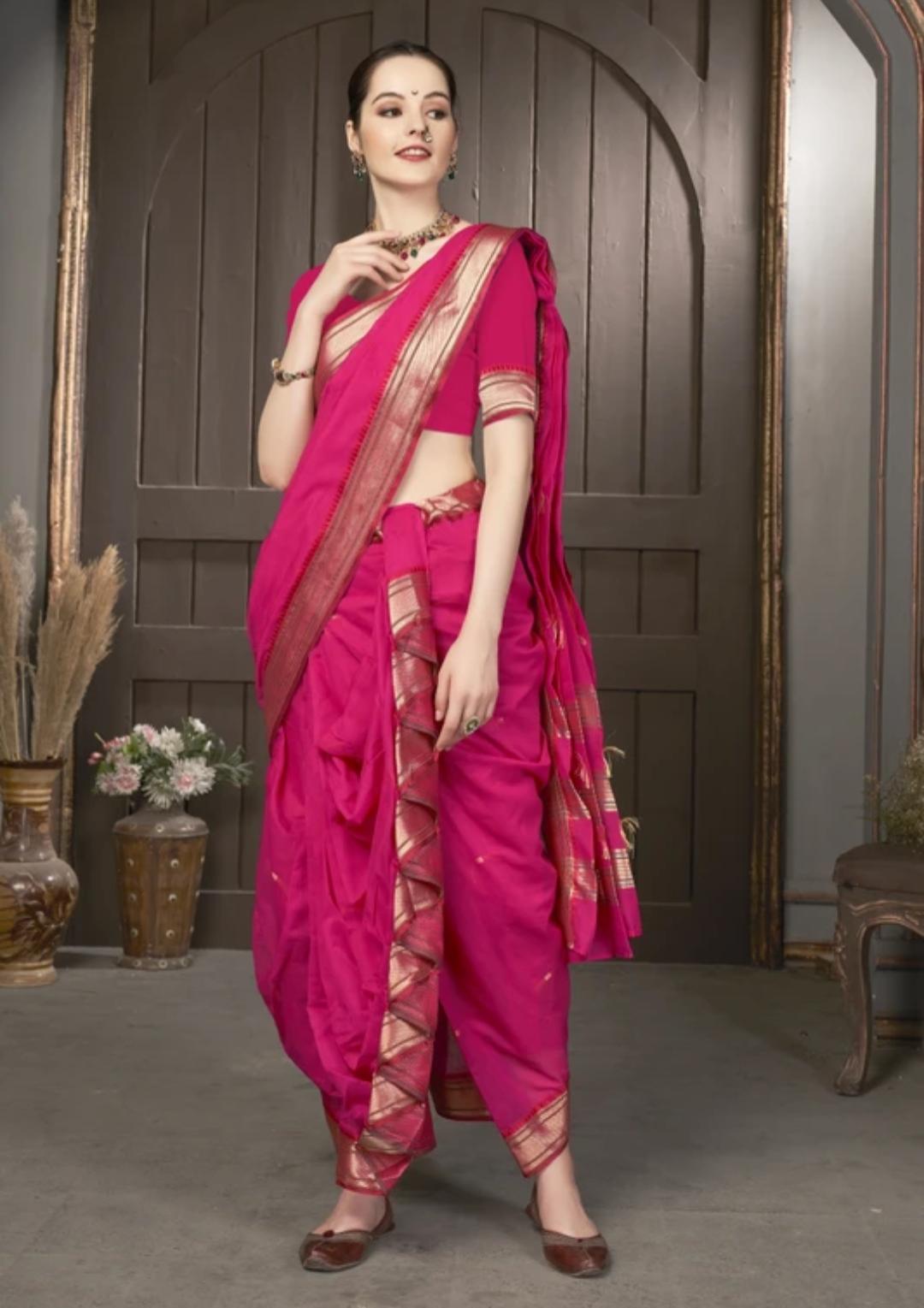
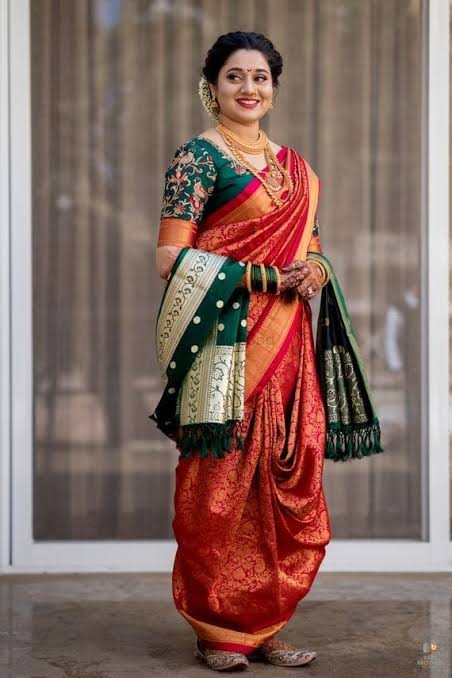
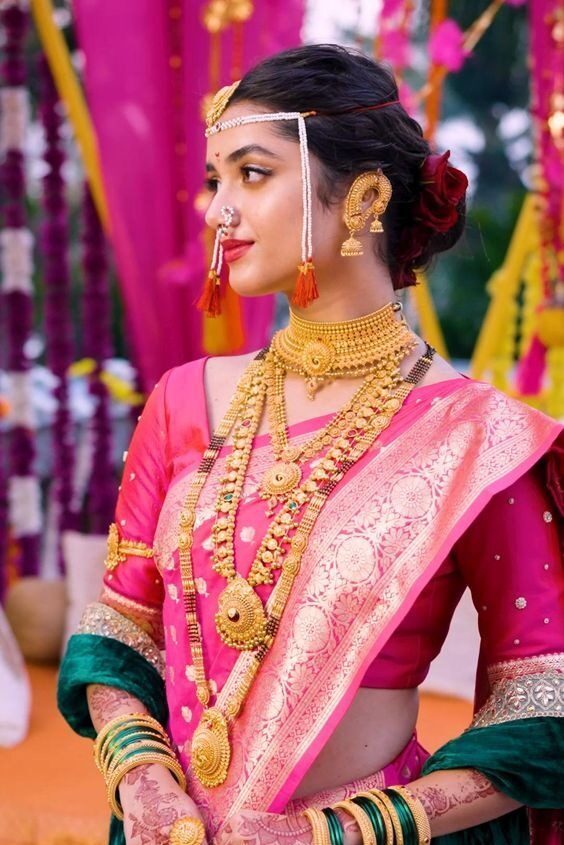
Nauvari saree, i.e., Nine Yards, has a historical context. It is believed that at the time of the Maratha empire, women were responsible for assisting their fellow male fighters. For better mobility, Maharashtrian women brought into existence the Nauvari saree, which looked like a man’s trouser. Ever since, it is the traditional women’s wear of Maharashtra. Wearing it reminds them of their proficiency in the masculine society and equal status in the past days, even in bad times. You can notice some women wearing Nauvari sarees at major festivals like Ganesh Chaturthi and Gudi Padwa festivals in Maharashtra. The Nauvari saree is named for its length. Nauvari is ‘nine’. A normal saree is about 5.5-6 yards, but a traditional Nauvari saree is of nine yards, which makes it unique.
Motifs
There are no such motifs designs for Nauvari sari.
- A traditional Nauvari sari has traditional geometrical motifs like triangles, squares, circles, some flowers, parrots, and trees.
- There is a floral pattern and complete jari work in floral on palla
- On the border, there are a few lines, shapes, dots, etc
Traditional colors
Green, yellow, or orange
Type of textile
Handloom based
Fibers used
Pure silk
Pune Induri saree
Introduction
Puneri cotton is one of the most well-known weaves of Maharashtra and a symbolic cloth of Pune. It is of the Maratha and Peshwa era. It was traditionally worn by the women of royal husbands and on some occasions, and it has a Zari border.
Fibers Used
100% cotton
Type of Textile
Handloom-based, woven with a yarn count of 100s
Motifs
Triangular motifs, complex temple architecture of pune, gomi, nav bharat, jijamata, and rudraksh.
Traditional colors
Pink, red, orange, blue, green.
Karvath kati
Introduction and History
The Karvath Kati sarees, a celebration and prosperity symbol originates from the Vidarbha region of Maharashtra. Worn at auspicious ceremonies and at weddings they are also traditionally worn by the Vidharbha bride. This traditional saree is referred to as Karvat Kati because of its distinctive saw-edged design on the border.
Place
Kavarth kati of Vidarbha
Type of textile
Pit loom based
Fibers used
Tussar silk for field and cotton for boarders
Motifs
The sari bodice also features patterns similar to the saw teeth pattern. The weavers have borrowed these patterns from the sculptures found at the renowned Ramtek temple in the area.
Traditional colors
Beige and shades of brown
Khan saree
Place
Made in Solapur district
Fibers Used
Art silk or Cotton silk
Traditional colors
The border typically has a maroon background color, sometimes black background of the body and design can be blue, green, grey, golden yellow, yellow, magenta etc. Used in contrast combination.
Weaving technique
Designs are created by Dobby loom and additional warp yarn. It’s purely fabric for a saree blouse; therefore it is 27 or 31” width.
Design
Two lines of designs are woven on the border; either floral or narali border etc.
On the body, small designs are woven to fill the entire surface with extra warp yarns.
Motifs
Floral, geometrical, surajmukhi, tilpatta, chanabutta, etc.
Narayan Peth
Place
Historically between Maharashtra and Andhra Pradesh.
Introduction and History
Historically produced using vegetable dyes, a special process in which eight sarees are produced at one time on loom i.e 56 yards of silk are placed on the loom at one time. Received Geographical Indicator (GI) in 2012.
Fibers used
Silk, cotton or Garbha Reshmi (silk in warp & cotton in weft), Garbha Suti (cotton in warp & silk in weft).
Traditional colors
Navy blue/ Turkish blue with Pink, green with pink/ red, Black with pink or red. Golden yellow with red, orange with brown, peacock green with blue, Green and Purple. Pallu and border will always be of same colour.
Manufacturing method
Cotton saree is completed in one day and Silk saree in 4-5 days.
Style- 4” wide border (kath), Piecing method of Padar i.e warp and weft always of silk.
Body- Plain, checks or very rarely vertical stripes.
Pallu- It is called Tope Padar. It contains 3 zari stripes between silk padar. Each zari strip ends with 3 or 5 pointed edges
Border- 4” wider border
Motifs
Every row is made up of tiny squares with a flower design named Rudraphul or mango design named Kairi. Temple or mango motifs are placed on top of the saree border.
Mashru
Place
Mashru of Aurangabad
Introduction
Mashru a satin weave fabric in which the warp is silk yarns and the weft is cotton yarns. The fabric is worn especially by Muslims because they are not allowed to wear pure silk against skin.
Fibers Used
Cotton and Silk
Traditional colors
The stripes are always of bright colors
Weaving technique
It is constructed from plain Handloom. The warp yarns are smooth, plain yarns. The weft is constructed of club yarns to provide an irregular texture and uneven pattern to the fabric.
Arts and Crafts
Bidriware
Introduction
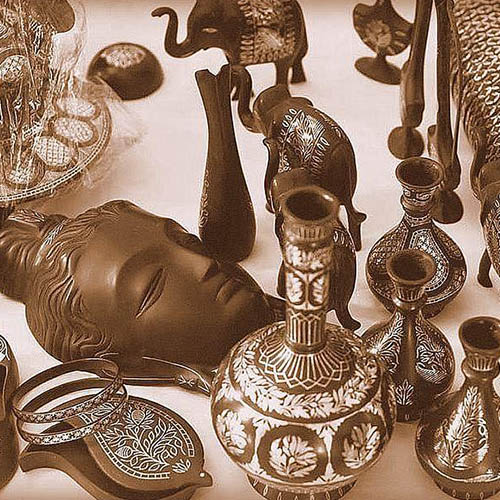
Bidriware or the Birdri craft is one of the most popular handicrafts of Maharashtra. It has been in existence since ages and found patrons amongst the Mughal rulers. Initially used for embellishing royal swords and other weapons, the craft later spread to domestic items like cigars and cigarette boxes. The typical items adorned with bidriware are plates, bowls, vases, ashtrays, trinket boxes, hukka bases, jewelry, glass and studded bangles, etc.
Warli paintings
Introduction
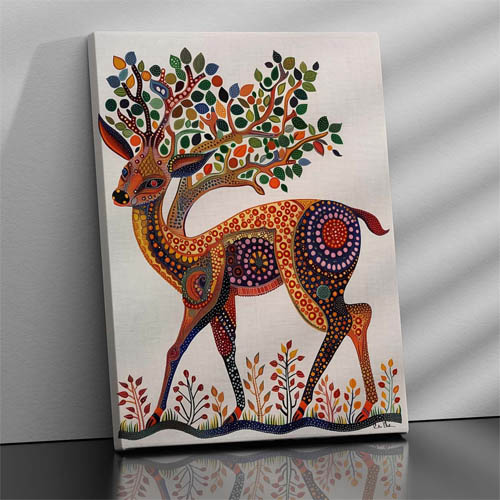
Maharashtra is home to a large number of tribes, most of which are found residing around the Deccan region. Apart from their distinct culture and lifestyle, the tribal people of the state are also known for making a number of handicrafts. Amongst the popular folk crafts of the tribes are the Warli paintings
More
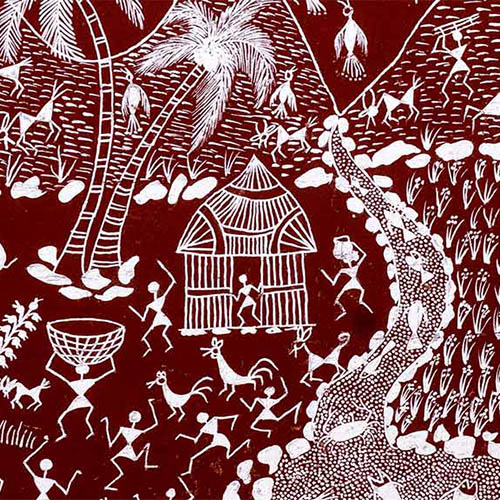
The paintings of warli tribes of Mumbai. It is even compared to the famous paintings of Madhubani, Bihar. Warli paintings are the tribal wall paintings of the warli tribes of Maharashtra. Warlis are the largest tribes of Maharashtra living in the northern outskirts of Mumbai. Womenfolk mainly do the paintings on the mud walls of the houses. This art is done in a very traditional way . First the coating of cow dung is done on the walls and to brighten up the shade mud is polished over it as a primer coating. Rice powder and straw are the main mediums used for paintings which are then mixed in a traditional metal vase and with the thin sticks prepared out of Beharu tree are used as a source of painting. The paintings have compositions of human figures as well as animals , insects and birds. Interesting to know is that the lady whose husband is alive can only draw the main elements of the composition. The main element is the mother goddesses Palghata. Today this art is not only limited to walls but also on papers and is available for purchasing.
Bhils paintings
Introduction
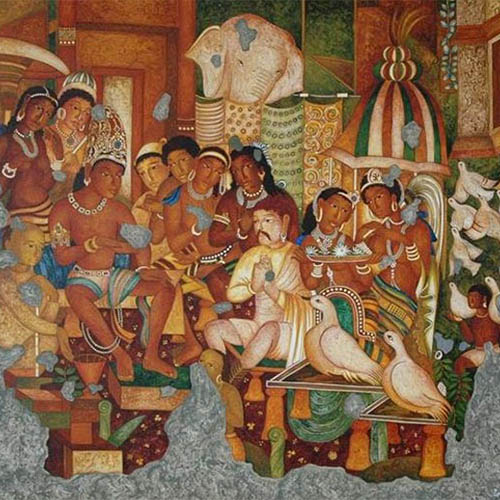
Bhils have a rich and unique culture. The Bhil Tribe are indigenous, being the Second largest Tribal Community in India. Art is Integral to the Bhil Community. The rich texture of their paintings generally depict nature and Adivasi Style that is their legacy. Bhil artists are just starting to be internationally recognized. They paint the simple human joys of birth and other ceremonial occasions like harvests that are often forgotten in our modern society. The art of the Bhils along with that of other tribal groups reminds us what the simple pleasures in life are. Traditionally, the art of the Bhil folk would adorn the clay walls of their village homes. Beautiful images would be painted with neem sticks and other twigs, and natural dyes would be used. Turmeric, flour, vegetables, leaves and oil were used to derive brilliant colors to make fascinating frescoes on floors and walls, in a language created by the Bhils, to convey their experiences
More
The Bhilala sub-division is known for its Pithora painting. Bhil painting is characterized by the use of multi-coloured dots as in-filling. Bhuri Bai was the first Bhil artist to paint using readymade colors and paper. Other known Bhil artists include Lado Bai, Sher Singh, Ram Singh and Dubu Bariya.
Ajanta paintings
Introduction
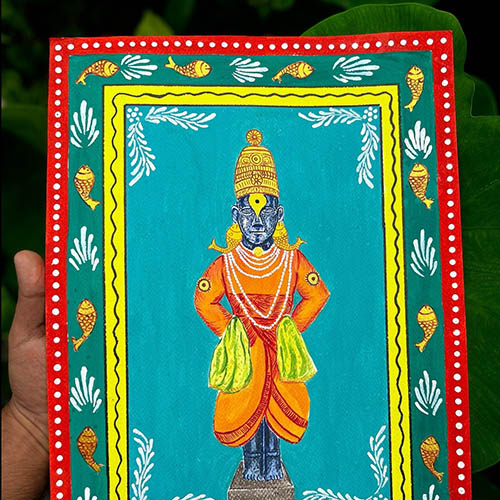
The Ajanta caves were lost in time and it was not until the 19th century these caves were unearthed from the thick undergrowth by a company of British soldiers.
These caves predominantly represent Buddhist thoughts which have been frozen on walls of these caves since 2nd century B.C to 7th century A.D. There are 30 Chaityas and Viharas which have paintings illustrating the life and incarnations of Buddha. Five caves (9, 10, 19, 26 and 29) are Chaitya-Grihas and the rest are Sangharamas or Viharas (monasteries). The caves 1, 2, 16 and 17 are ranked high among the greatest artistic works of the contemporary world. Each one of these paintings reflect the finesse of the craftsmen and leave visitors spellbound. The Ajanta caves were meant to provide seclusion to the Buddhist monks who took solace in the fact that they were in serene surroundings in midst of numerous images of Buddha, Nymphs and Princesses. The female figures in the paintings of Ajanta display the true mastery of the artists who have used a magnificent array of colors, hairstyles, poses and costumes.
Chitaris paintings
Introduction
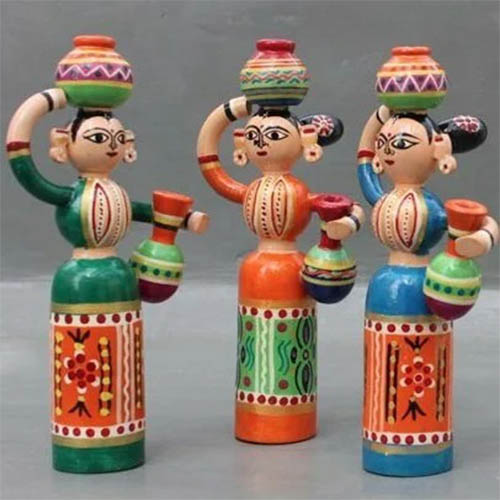
Chitaris is the Marathi word for a painter. A large number of chitaris settled in Nagpur, drawn there by the liberal patronage of the rulers of the Bhonsale dynasty who celebrated Hindu customs and traditions with great pomp and reverence. These chitaris made their homes in the Mahal areas of Nagpur and even today their descendants are found to be living there in a lane known as Chitari Oli.The chitaris’ work consists of making objects required during Hindu festivals. The rituals connected with them often require readymade artifacts in wood, clay, and paper. Ganpati has a special significance and the chitaris produce clay images for installation during the Ganpati festival. Over the years changing tastes have lead to a decline in the demand for their work. Today there are only a few families practising in Nagpur.
Sawantwadi toys
Introduction
Sawantwadi is the name of a taluka in the Sindhudurg district of Maharashtra. The taluka is mainly known for being associated with the craft of lacquer ware, popularly known as the Sawantwadi craft. They mainly produce wooden toys with lacquer applied on it known as Sawantwadi toys. The craft was introduced in the Sawantwadi somewhere around the end of the 17th century.
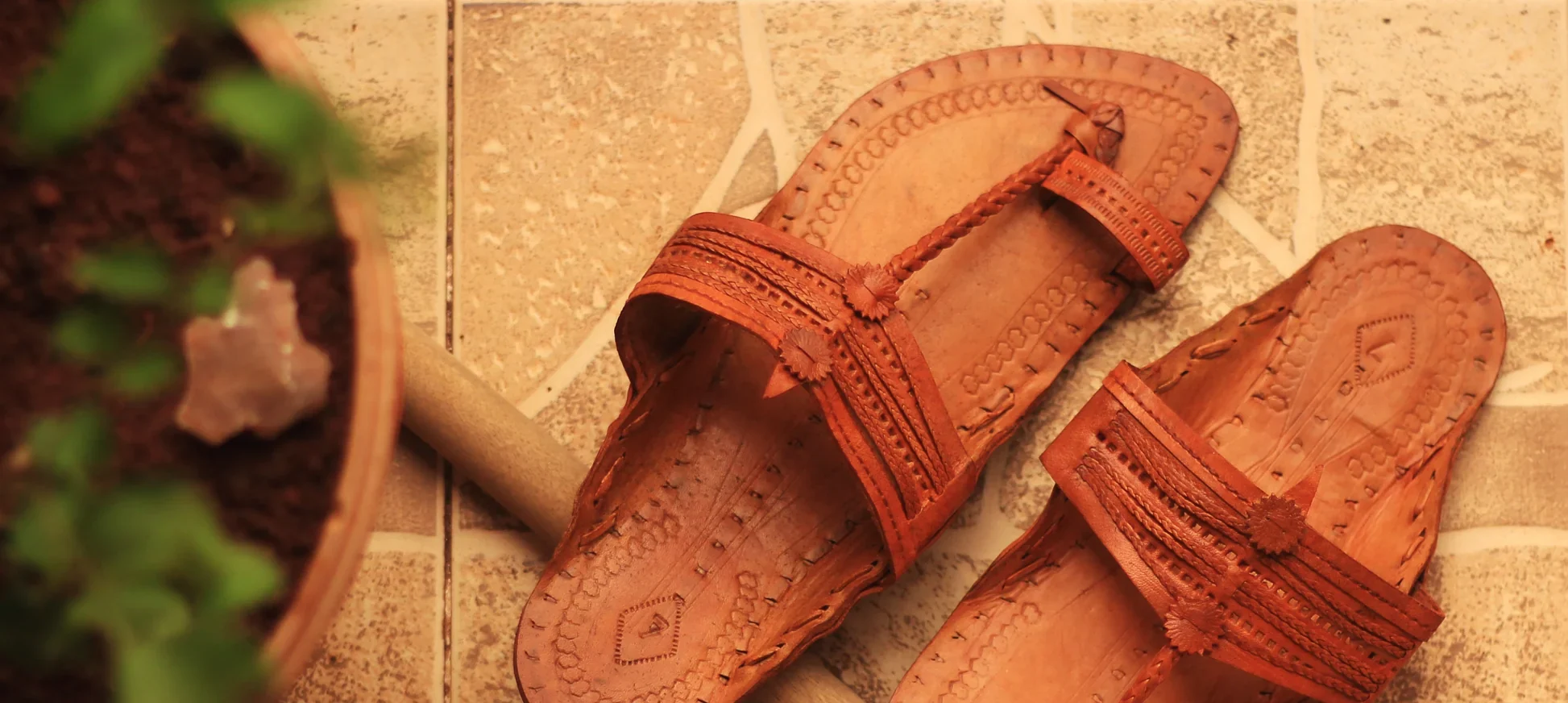
Kolhapuri chappals
Introduction
Kolhapur is one of the few cities in Maharashtra that are renowned for being home to rich arts and crafts. Amongst its most popular crafts are its beautiful jewelry and extremely comfortable chappals (slippers). The chappals and sandals produced in the city are handmade. Kolhapur is Famous for hand-made leather footwear popularly known as Kolhapuri Chappals. Kolhapuri chappals are famous for their simple designs, style, and fine quality of leather. Kolhapur, the famous city of Maharashtra is also recognized as a Religious Tourist place along with traditional arts.